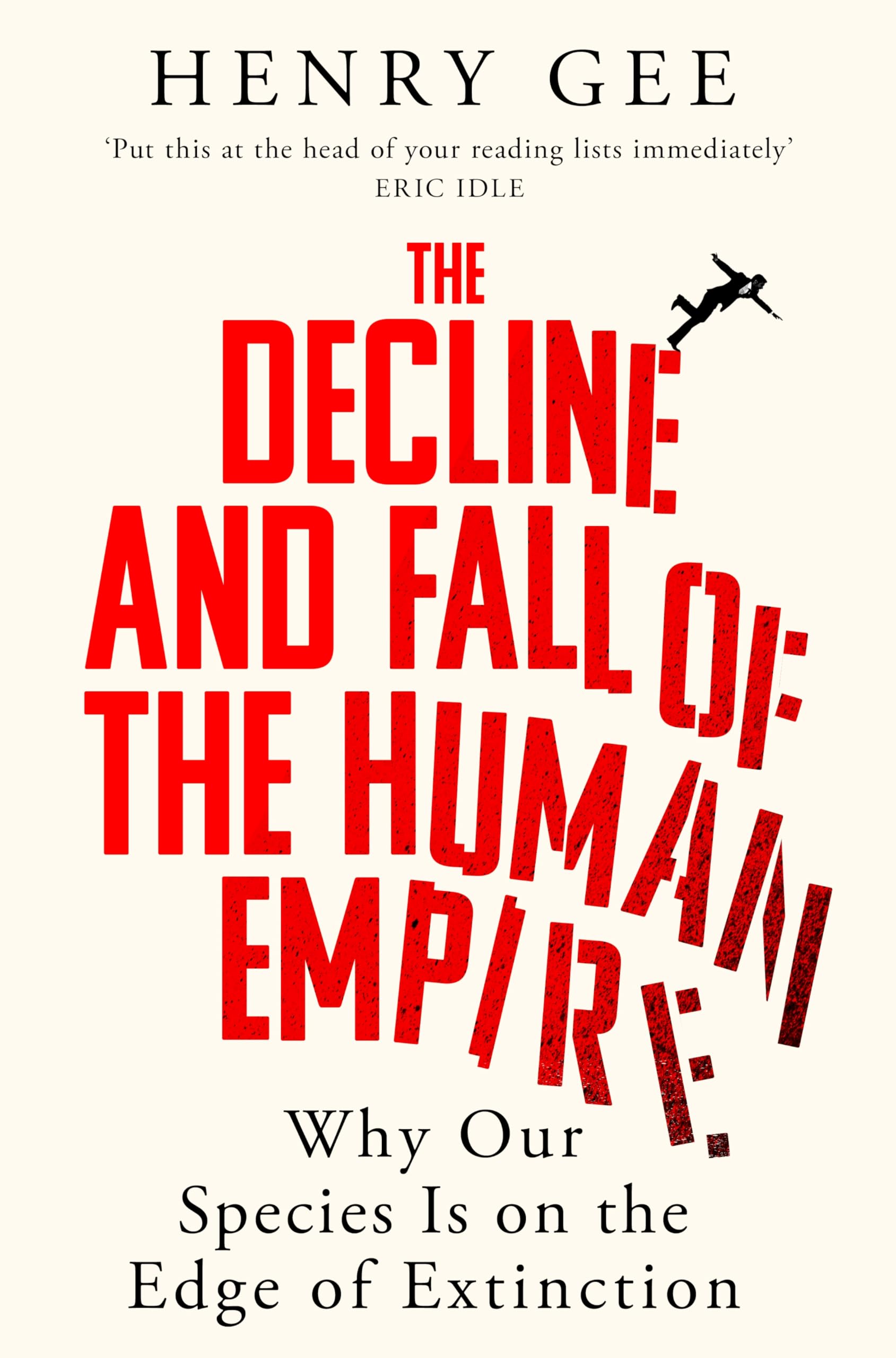
The Decline and Fall of the Human Empire
Why Our Species Is on the Edge of Extinction
Novinka
From the winner of the 2022 Royal Society Science Book Prize, a thrilling and thought-provoking account of the rise and fall of humankind.
For the first time in over ten millennia, the rate of human population growth is slowing down. The global population is forecast to begin declining in the second half of this century, and in 10,000 years’ time our species will likely be extinct.
In The Decline and Fall of the Human Empire, Henry Gee shows how we arrived at this crucial moment in history, beginning his story deep in the palaeolithic past and charting our dramatic rise from one species of human among many to the most dominant animal ever to live on Earth.
But rapid climate change, a stagnating global economy, falling birth rates and an unexplainable decline in average human sperm count are combining to make our chances for longevity increasingly slim. There could be a way forward, but the launch window is narrow . . .
Drawing on a dazzling array of the latest scientific research, Gee tells the extraordinary story of humanity with characteristic warmth and wit, and suggests how our exceptional species might avoid its tragic fate.
Review
The wake up call our species needs . . . a strangely engrossing read, addictive because of its continuum of interesting facts . . . garnished with wit and humour ― The Conversation
A wide-ranging look at the human past and the possibility of our species' extinction . . . serious but nonetheless entertaining ― Kirkus Reviews
A sweeping account of humanity's evolutionary history and possible future. Gee writes engagingly while maintaining scientific rigour' ― H-Net
Henry Gee wrote my favourite book of last year and has now written my favourite book of this year. How he manages to expand my mind, and my knowledge of life on earth, while making me giggle at our own forthcoming extinction, well, t’aint natural. Put this at the head of your reading lists immediately, people. Before it’s too late -- Eric Idle
Exhilarating . . . With the witty and conversational style that won him the Royal Society Science Book prize, Henry Gee tackles the existential question of humanity’s future. Measured and enlightening, Henry Gee is a sage -- Steve Brusatte, author of The Rise and Fall of the Dinosaurs
Like Jared Diamond meets Arthur C. Clarke with a dash of Douglas Adams, this deserves to be widely read and debated -- Philip Ball, author of How Life Works and Critical Mass
A fascinating, deeply researched study of our evolutionary journey and a wonderfully enjoyable adventure -- Michael Bond, author of Wayfinding
Beautifully crafted, superbly researched, witty, with lashes of humour . . . Compulsory reading for all humans, mandatory reading for politicians -- John Long, author of The Secret History of Sharks
Thought-provoking, and backstopped by the latest research. Gee is a terrific writer: graceful, intelligent, witty -- Harry Turtledove
About the Author Henry Gee is a senior editor at Nature and the author of several books, including The Decline and Fall of the Human Empire, Jacob’s Ladder, In Search of Deep Time, The Science of Middle-Earth, The Accidental Species, and A (Very) Short History of Life on Earth, which won the 2022 Royal Society Science Book Prize. He has appeared on BBC television and radio and NPR’s All Things Considered, and has written for The Guardian, The Times, and BBC Science Focus. He lives in Cromer, Norfolk, England, with his family and numerous pets.
Další knihy od tohoto autora
Diskuze
Žádný příspěvek do diskuze. Přidejte svůj názor »
|