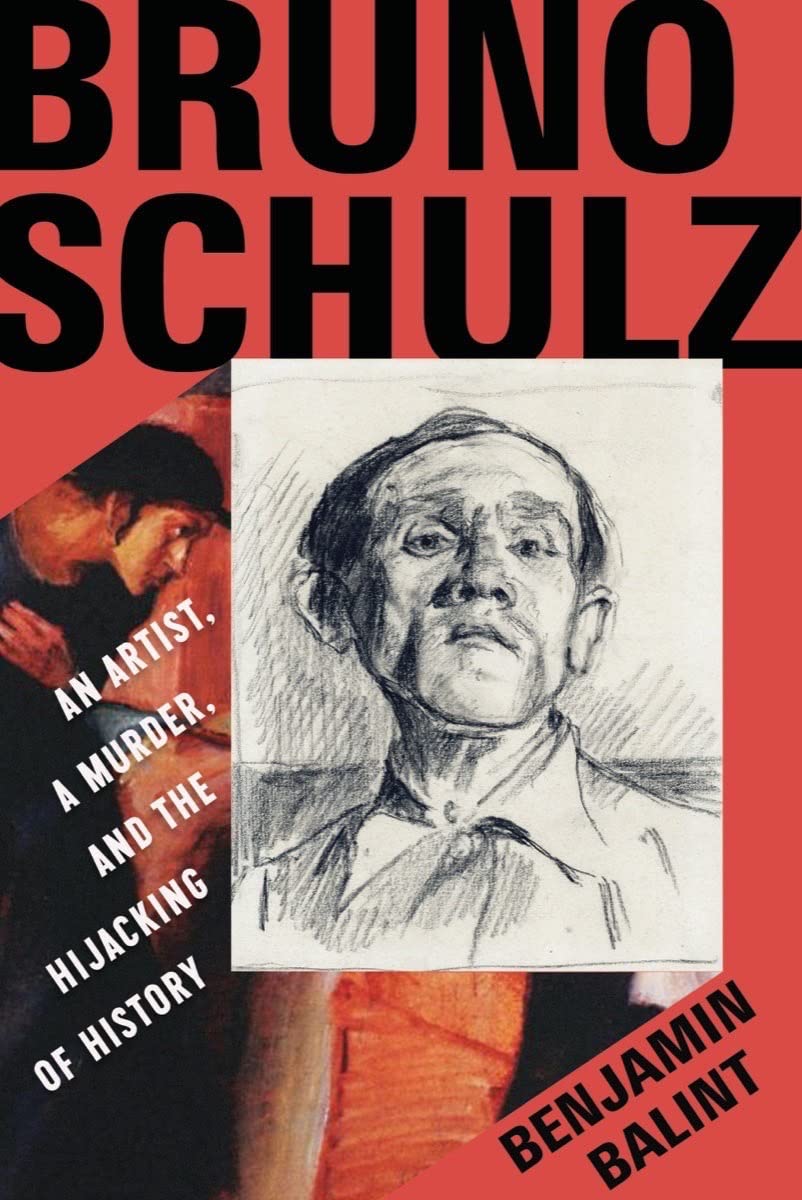
Bruno Schulz: An Artist, a Murder, and the Hijacking of History
Winner of the 73rd National Jewish Book Award for Biography
A New York Times Book Review Editors' Choice
A fresh portrait of the Polish-Jewish writer and artist, and a gripping account of the secret operation to rescue his last artworks.
The twentieth-century artist Bruno Schulz was born an Austrian, lived as a Pole, and died a Jew. First a citizen of the Habsburg monarchy, he would, without moving, become the subject of the West Ukrainian People’s Republic, the Second Polish Republic, the USSR, and, finally, the Third Reich.
Yet to use his own metaphor, Schulz remained throughout a citizen of the Republic of Dreams. He was a master of twentieth-century imaginative fiction who mapped the anxious perplexities of his time; Isaac Bashevis Singer called him “one of the most remarkable writers who ever lived.” Schulz was also a talented illustrator and graphic artist whose masochistic drawings would catch the eye of a sadistic Nazi officer. Schulz’s art became the currency in which he bought life.
Drawing on extensive new reporting and archival research, Benjamin Balint chases the inventive murals Schulz painted on the walls of an SS villa―the last traces of his vanished world―into multiple dimensions of the artist’s life and afterlife. Sixty years after Schulz was murdered, those murals were miraculously rediscovered, only to be secretly smuggled by Israeli agents to Jerusalem. The ensuing international furor summoned broader perplexities, not just about who has the right to curate orphaned artworks and to construe their meanings, but about who can claim to stand guard over the legacy of Jews killed in the Nazi slaughter.
By re-creating the artist’s milieu at a crossroads not just of Jewish and Polish culture but of art, sex, and violence, Bruno Schulz itself stands as an act of belated restitution, offering a kaleidoscopic portrait of a life with all its paradoxes and curtailed possibilities.
8 pages of color illustrations
Review
"Balint tells this story―which turns out to be multiple stories, obscured by the fog of war and rumor’s sfumato―and virtuosically relates them to Schulz’s own tales, while providing the clearest, most evenhanded account to date of the tangled afterlife of the Master of Drohobych.... [Balint is] an unflaggingly curious and fastidious critic.... and demonstrates with sensitivity how in the clash between so-called intellectual property rights and so-called moral rights, the only sure loser is the artist himself, especially if he is no longer around to defend (or define) himself."
― Joshua Cohen, New York Times Book Review (Editors' Choice)
"Offers not just an astute biographical portrait but an investigation into the contested rituals of remembrance.... Balint’s meticulous account of the ‘fresco fiasco,’ which saw Schulz’s last works forcibly claimed by the Israeli state, raises grave issues about ‘the stewardship of suffering.’"
― Boyd Tonkin, Wall Street Journal
"A perfect sequel to Balint’s previous book, the award-winning Kafka’s Last Trial."
― Adam Kirsch, New Republic
"I’ve never before read [a biography] that caused me to bolt upright midway through, as if its subject had just come back from the dead."
― Kathryn Schulz, The New Yorker
"Balint reflects on the meaning of the controversy over who owns Schulz’s murals―a debate about the location of Jewish memory and the question of its legitimate home-land. ‘How does Schulz’s orphaned art,’ he asks, ‘figure in the politics of erasure?’ It is a poignant, cosmic question with no easy answers."
― Donald Weber, Jewish Book Council
"What a wonderfully empathetic biography Balint has written, so vividly does he bring Schulz back to life, both as a writer and an artist of prodigious, otherworldly talents."
― Tobias Grey, Airmail
"Fascinating.... [A] book of unique importance regarding national memory and commemoration."
― Ephraim Zuroff, Jerusalem Report
"Schulz’s destiny is terrifying and exemplary, and Balint retells his life in captivating fashion."
― David Mikics, Tablet
"[Schulz’s] reach, eventually, was global. The cult of Schulz, counting literary household names like Philip Roth, Jonathan Safran Foer, and Isaac Bashevis Singer (who, Balint gossips, liked Schulz better even than Kafka), proves it.... Schulz gets compared to Kafka because of his dreamy, disconcerting stories, but in Balint’s book, a version of Schulz emerges that is closer to one of Kafka’s characters."
― Leo Lasdun, The Millions
"Balint’s account of Schulz’s life and art is rich and captivating. . . . Schulz the visual artist is still too little and too imperfectly known. Much work remains to be done on this aspect of his creativity, and to recentre our understanding of his artistic legacy alongside his legacy as a writer. Bruno Schulz makes a significant step in this direction, and will be of interest to both the scholarly and the casual reader. For the success of this effort, Balint merits much praise."
― Marta Figlerowicz, Jewish Quarterly
"An important new account that sheds light on many previously unknown aspects of Schulz’s life and posthumous existence.... A welcome addition to our fund of information about a remarkable European master."
― Ewa Hryniewicz-Yarbrough, American Scholar
"Balint does a fine job of capturing Schulz’s life and his world before the war, his deeply peculiar mind and the fascinating figures in whose orbit he moved."
― Joe Moshenska, The Observer
About the Author
Benjamin Balint is the author of Bruno Schulz and Kafka's Last Trial, awarded the 2020 Sami Rohr Prize for Jewish Literature, and is coauthor of Jerusalem: City of the Book. A library fellow at the Van Leer Institute in Jerusalem, he regularly writes on culture for The Wall Street Journal, the Jewish Review of Books, and other publications.
Další knihy od tohoto autora
Diskuze
Žádný příspěvek do diskuze. Přidejte svůj názor »
|