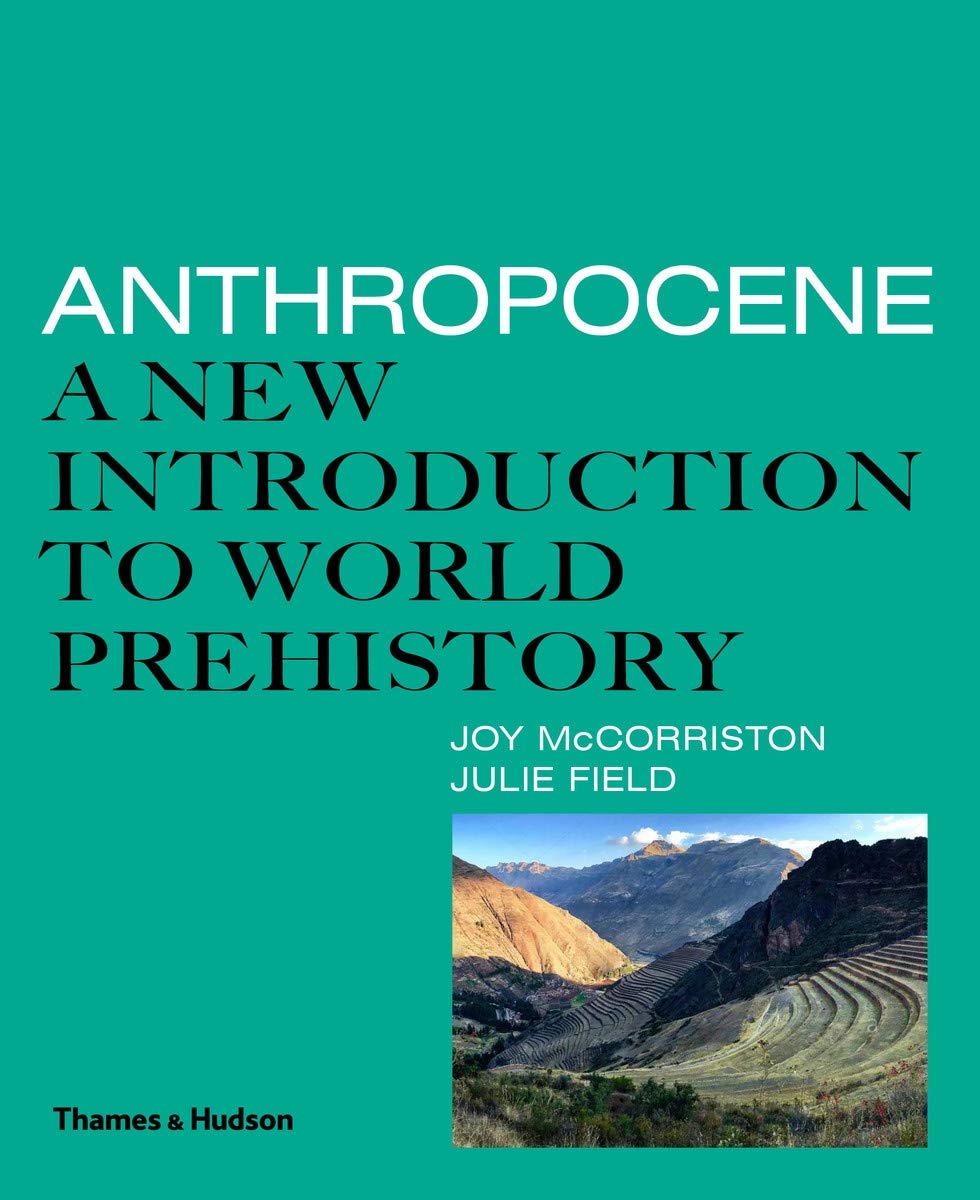
Anthropocene: A New Introduction to World Prehistory
A groundbreaking new textbook that brings a highly topical, environmental perspective to the story of how humans have shaped the world Since taking their first steps on this planet, humans have changed the environment around them. Anthropocene: A New Introduction to World Prehistory tells the comprehensive story of human prehistory through the lens of anthropogenic environmental change. Each chapter explains how and why ancient humans transformed the Earth, linking prehistory to today’s greatest global challenge.
As they explore this record of the world’s early people and societies, authors Joy McCorriston and Julie Field reject the traditional account of cultural evolution, instead presenting a thematic organization that highlights our Anthropocene narrative. Chapters are devoted to cities and agriculture, but also to such topics as technology, extinction, food production, writing and extractivism. Chapter 9, ‘Individuals and Identity,’ considers human identity and agency in more recent eras, and the book ends with a contemporary chapter that takes a hopeful look at the future.
'I love the inclusive nature of its content in terms of global prehistory – it covers geographies and cultures that are often neglected in the teaching of archaeology'
James Taylor, University of York
Contents List
1. Archaeology and the Anthropocene What Is the Anthropocene? • The Perspective of Archaeology • Polynesia and the North Atlantic: Islands as Laboratories • Methods: Survey and Excavation • How Have Humans Made Their World?
2. Discovering Diversity: Modern Human Origins Diversity of Humans: Homo sapiens and Neanderthals • Modern Humans • Lascaux Cave and the Human Experience of the Ice Age • Additional Human Experiences in the Ice Age • Human Culture Begins to Shape the Anthropocene • Protecting Cultural Diversity
Global Timeline 1: Human Origins and Migrations
3. Technology Makes the Human: Stone, Metal, and Organic Material Culture Stone Tools and the Discovery of Time • The Mechanics of Flintknapping • Stone Tools as Evidence of Human Adaptation • Metalworking, a New Technology for Communities • Perishable Technologies: Revelations from the Iceman • Technology, the Environment, and the Anthropocene
4. Peopling the World: Human Dispersals to Australia, the Americas, and the Pacific Inhabiting Australia • Human Dispersals in the Americas • Inhabiting the Pacific • Methods: Archaeological Survey • Peopling and the Anthropocene
Global Timeline 2: People and Societies
5. Digging In: Responding to Climate Change in the American Southwest The American Southwest • Methods: Excavation • The Colorado Plateau and the Chaco Phenomenon • Understanding Ancient Pueblo Society: Broken K Pueblo • Other People of the Southwest • The Southwest and the Changing Environment
6. Extinctions in the Past Big Game Hunters: The Clovis People • Radiocarbon Dating • The Spread of Clovis • Hunting Megafauna • Mastodons and the Role of a Changing Environment • South America: The Giant Ground Sloth • The Role of Humans in Extinction Events
7. Understanding Human Decisions: Evolutionary and Social Theory Bison Hunters of the American Great Plains • Zooarchaeology • Bison Hunting and Butchering in Context • South Pacific: Conflict and Fortification in Fiji • Europe: Deciding With or Against a Community in St. Kilda • The Amazon: Decision-Making Today
8. Producing Food: Domestication and Its Consequences in Southwest and East Asia Southwest Asia: The First Settlements • What Led to the Development of Farming? • Archaebotany and the Evidence for Food Production • Domestication: A Two-Way Process • China: Independent Domestication and Rice • The Consequences of Farming • The Critical Role of the Community in Food Production
Global Timeline 3: Domestication
9. Individuals and Identity: Agency in History Studying Identity • Mesoamerica: The Aztecs • Cortés and La Malinché • Textiles, Identity, and Gender • Bioarchaeology • Inequality and Structural Violence in Prehistory • Agency, Identity, and the Anthropocene
10. Feeding Cities: Urbanism and Agriculture Mesoamerica: Discovering the Maya • Maize and the Maya • The Maya City • Southeast Asia: Irrigation and Agriculture at Angkor • The State • The Environmental Perils of Intensification • Cities, Surplus, and the Elite
11. Building Monuments, Building Society: Collective Labor as Social Identity Monuments and Landscapes • Ancient Egypt: Building the Egyptian State • Monuments Among Mobile Communities • Stonehenge and the Pastoralist Landscape of Neolithic Britain • North America: The Hopewell Earthworks
12. Conspicuous Consumption: Feasts, Burials, and Sacrifice Chiefs and Hoards • Feasting • Residue Analysis • Reciprocity • The Ultimate Sacrifice: Human • Europe: The Burial of Viking and Anglo-Saxon Ships • Is Conspicuous Consumption Inevitable?
13. Writing: A History of Access to Information Writing in Many Contexts • Writings of the Maya • Writings of the Sumerians • Ancient Chinese Writing • Alphabetic Writing • Preservation of Writing Systems • Without Writing: Systems of Notation • North Africa and Arabia: Literacy without Settlement • Writing and the Anthropocene
14. Extracting the Modern World: Fishing, Mining, and Slavery Extractivism, Markets, and the Environment • Fishing and Maritime Extractivism • Underwater Archaeology • Extracted Minerals in the New World • Extracting People: The Slave Trade • Extractivism and the Anthropocene
15. The Future of the Anthropocene The Challenges Ahead • Extinctions and Increasing Diversity • Population Growth • Fossil-Fuel Consumption and Innovation • Understand Your Agency
Glossary Sources of Quotations
Sources of Illustrations
Index
About the Author
Joy McCorriston is Professor of Anthropology at The Ohio State University. She researches food production, landscape and paleoenvironments in the ancient Near East and co-directs field research in Arabia.
Julie Field is Associate Professor of Anthropology at The Ohio State University. Her research focuses on the archaeological detection of human–environmental interaction, in particular the colonization and transformation of islands by Pacific Island voyagers.

Podrobnosti
| Autor |
Joy McCorriston Julie Field |
|---|---|
| Vydavatel |
Thames & Hudson |
| Jazyk | anglicky |
| Vazba | měkká |
| Počet stran | 376 |
| Formát | 18,7 × 22,9 cm |
| EAN | 9780500052143 |
| Rok vydání | 2020 |
| Edice |
Historie Společnost a společenské vědy |
Autor
Joy McCorriston
Julie Field
Podobné knihy

The Death of Hitler: The Final Word on the Ultimate Cold Case: The Search for Hitler’s Body