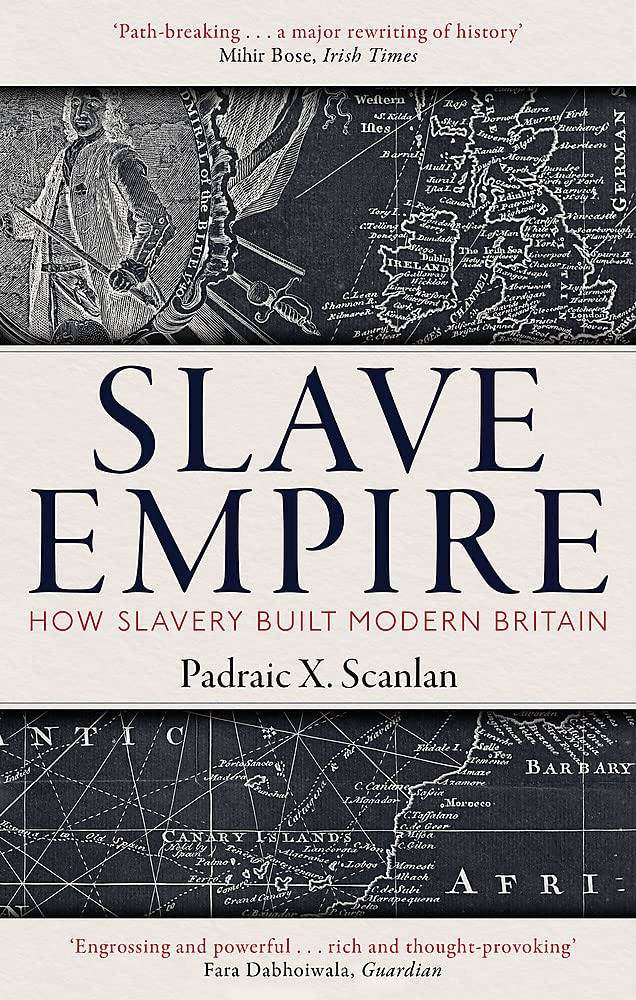
Slave Empire: How Slavery Built Modern Britain
The idea that the British empire was built on freedom is a myth. Britain rose to global power in the eighteenth century on the backs of enslaved workers. And although Britain was the first European empire to abolish slavery, even British abolitionism was shaped by the slave empire.
The British empire, in sentimental myth, was more free, more just and more fair than its rivals. But this claim that the British empire was 'free' and that, for all its flaws, it promised liberty to all its subjects was never true. The British empire was built on slavery.
Slave Empire puts enslaved people at the centre the British empire in the eighteenth and nineteenth centuries. In intimate, human detail, Padraic Scanlon shows how British imperial power and industrial capitalism were inextricable from plantation slavery. With vivid original research and careful synthesis of innovative historical scholarship, Slave Empire shows that British freedom and British slavery were made together.
Review
Fara Dabhoiwala, Guardian
'Path-breaking . . . a major rewriting of history'
Mihir Bose, Irish Times
'Slave Empire is lucid, elegant and forensic. It deals with appalling horrors in cool and convincing prose.'
The Economist
Scanlan writes about how the antislavery movement became its own political and economic force: a moralising stance for an empire which continued to profit from the global network of unfree labour. Britain's mills, for example, still processed cotton from the American South long after the slave trade in its colonies was abolished. -- Katrina Gulliver, Spectator
Padraic X. Scanlan has written a sweeping and devastating history of how slavery made modern Britain, and destroyed so much else. Ranging from Europe to the Caribbean, from West Africa to the new United States, Scanlan narrates the rise and fall of Britain's slave empire with an epic concision and an unwavering humanity. He also reveals, with unprecedented clarity and power, how the antislavery movement in Britain largely failed to accept Black equality. When the British parliament finally voted to end slavery in 1833, it paid a fortune in compensation to slaveholders and not a penny to enslaved people. Britain continued to rely on slave-produced cotton (especially from the United States) for decades, while in its own empire it replaced slavery with new forms of coerced labour and racial hierarchy. Most Britons have learned to deny or forget that their wealth was rooted in slavery, while occasionally congratulating themselves on their moral achievement of no longer enslaving people. Slave Empire offers a shattering rebuke to the amnesia and myopia which still structure British history. -- Nicholas Guyatt, author of Bind Us Apart: How Enlightened Americans Invented Racial Segregation
Padraic Scanlan is the leading historian of British antislavery in Africa. In Slave Empire, he tells the larger story of the British empire over two centuries, and sets slavery at the heart of political and economic history. The liberal empire of the nineteenth century, he shows, was the outcome of the long encounter of antislavery and economic expansion founded on enslaved or unfree labour. Antislavery was itself the excuse for empire. -- Emma Rothschild, Jeremy and Jane Knowles Professor of History, Harvard University
Scanlan's book is a fresh and fascinating new telling of the story of Britain's role in slavery and abolition in the Atlantic World. Slave Empire shows how an empire built on slavery became an empire sustained and expanded by antislavery. A stunning narrative, Slave Empire deftly combines rich storytelling with vivid details and deep scholarship. -- Bronwen Everill, author of Not Made By Slaves: Ethical Capitalism in the Age of Abolition
Lively and informative . . . there is a clear, almost textbook-like, account of the sugar plantation system . . . particularly good on the ill-fated 'apprenticeship' scheme that was linked to abolition after 1834. -- Krishan Kumar, University Professor and William R. Kenan, Jr., Professor of Sociology at the University of Virginia, author of Empires: A Historical and Political Sociology ― Times Literary Supplement
This accessible synthesis of recent scholarship comes at the right time to help shape current debates about Britain and slavery. -- Nicholas Draper, author of The Price of Emancipation: Slave-Ownership, Compensation and British Society at the End of Slavery
Scanlan writes about how the antislavery movement became its own political and economic force: a moralising stance for an empire which continued to profit from the global network of unfree labour. Britain's mills, for example, still processed cotton from the American South long after the slave trade in its colonies was abolished. -- Katrina Gulliver ― Spectator
Powerful, often devastating, always compelling. ― All About History
Freedom's Debtors interweaves a remarkably broad array of historical themes common to studies of abolition and post-emancipation societies, including contemporary notions of race and civilization, the tension between morality and profitability, and conflicts over land and labour. Scanlan does this remarkably well, in smooth, clear prose and with a keen eye for rich anecdotes and illustrations. These features, along with Scanlan's mastery of the sources and literature, make this book essential reading, not just for Africanists but for anyone interested in antislavery and abolition. -- Sean M. Kelley, Slavery & Abolition
Freedom's Debtors offers a much-needed account of how British abolitionist principles were developed and applied in West Africa . . . Scanlan's study emphasises how British and other non-African actors developed and profited from new forms of coercive labor as a result of the abolition of the slave trade . . . Scanlan's book provides a strong foundation for exploring the connections between the 'abolitionist' laws and policies imposed on Sierra Leone's 'Liberated Africans' and those that were applied to other imperial subjects during this dynamic time of ideological revolution and global expansion. -- Trina Leah Hogg, Journal of African History
Padraic Scanlan has not only written an excellent book on Sierra Leone, he has produced one of the most important books ever written on Liberated Africans . . . Freedom's Debtors is essential reading . . . Scanlan powerfully re-centres our understanding of abolitionism and forces us to re-examine its immediate and long-term effects in Africa. -- Matthew S. Hopper, Journal of British Studies
Based on exhaustive research within British missionary and personal papers as well as documents in the Sierra Leone archives, [Freedom's Debtors] . . . breaks conceptual ground and charts a new historiographical direction. Scanlan makes connections between the logic of capitalism and its intersection with colonialism and slavery. He demonstrates how British West Africa was enmeshed with economic systems at a global level and by taking the focus away from Europe, he challenges the prevailing narratives of abolitionism and colonialism. His argues convincingly that without slavery, without colonial 'outposts', capitalism and freedom might have evolved differently. This compelling book makes a huge contribution to our understanding of the processes which led to abolition but has wider implications for the historiography and the paradigms that inform it. ― Canadian Historical Association
Freedom's Debtors is timely, original, and lucid. Its analysis of the political, economic, and cultural forces that shaped the development of Sierra Leone challenges celebratory narratives about the abolition of the slave trade and offers a new account of life in this British colony. Padraic Scanlan's attention to the agency of West Africans and to 'British antislavery in practice' makes this work an important contribution to our understanding of the nature and locus of Atlantic history. ― American Historical Association
About the Author

Podrobnosti
| Autor |
Padraic X. Scanlan |
|---|---|
| Vydavatel |
Robinson |
| Jazyk | anglicky |
| Vazba | měkká |
| Počet stran | 464 |
| Formát | 12,4 × 19,4 cm |
| EAN | 9781472142337 |
| Rok vydání | 2022 |
| Edice |
Historie Společnost a společenské vědy |
Autor
Padraic X. Scanlan
Podobné knihy
Symbols of the Occult: A Directory of Over 500 Signs, Symbols and Icons
Flying Too Close to the Sun: Myths in Art from Classical to Contemporary