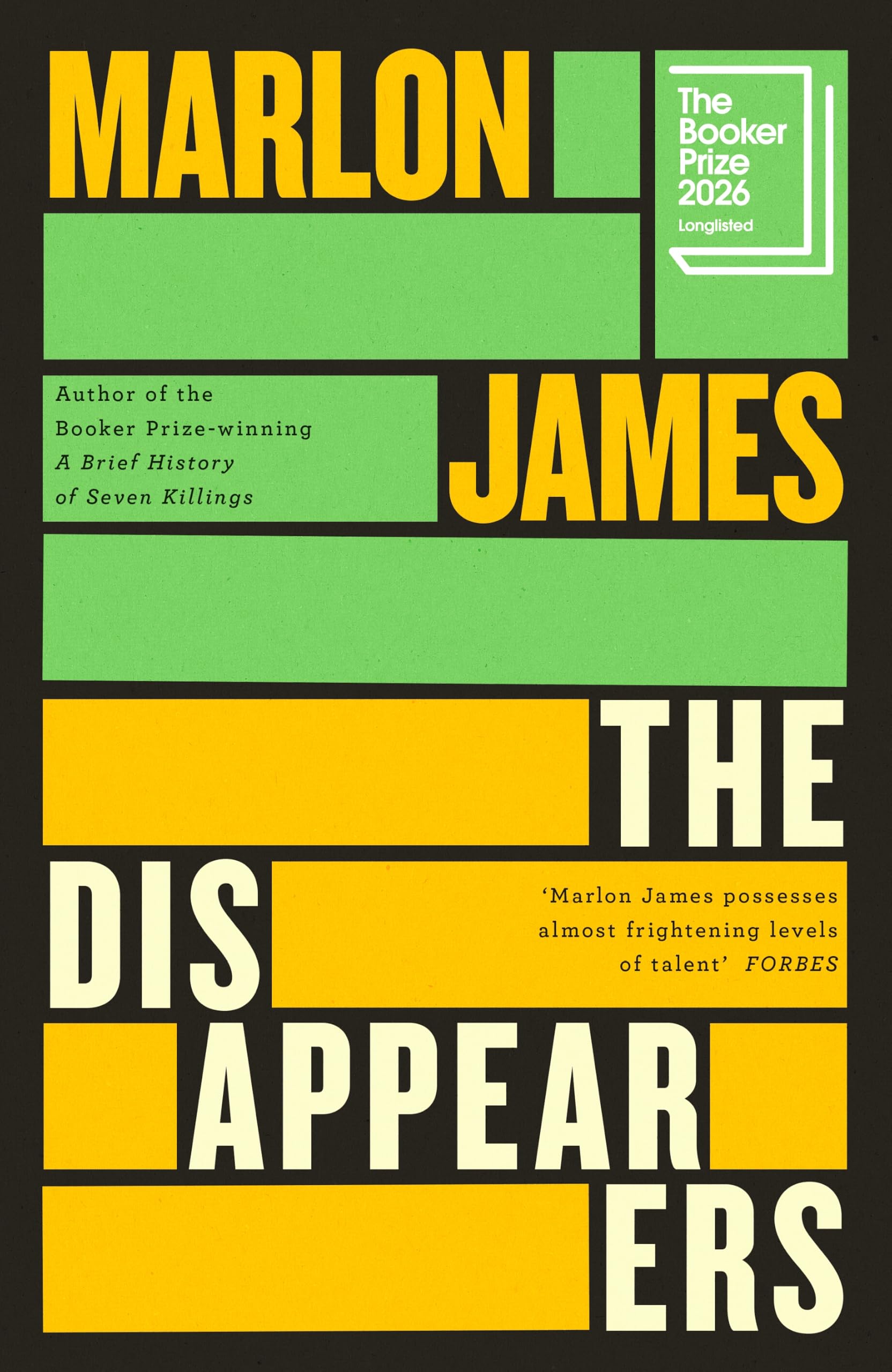
The Disappearers
MARLON JAMES'S TRIUMPHANT RETURN TO THE JAMAICA OF HIS BOOKER PRIZE-WINNING A BRIEF HISTORY OF SEVEN KILLINGS
‘Darkness is a mood in Jamaica . . .'
The Disappearers is Marlon James’s triumphant return to the Jamaica of A Brief History of Seven Killings – a place of heat and chaos, and of danger for anyone outside the heteronormal.
So when eight gay men meet for the first time, in Kingston in 1988, answering the casting call for an openly queer play, they are already taking a big risk. But that is nothing compared to what rains down on them when a mob descends on one of their rehearsals.
By the end of this night, one man is dead, all are injured, and two subsequently disappear. As the survivors heal, each man finds he must confront the bigotry and homophobia that the attack laid bare. Some try to forget; some embrace their rage; and some simply vanish – but all are forever scarred.
As one of the victims puts it, ‘there’s a difference between when something ends and when something stops’. And this story won’t stop until both the disappearers and the perpetrators have been tracked, along trails both hot and cold, and an ending reached.
Epic and intimate, violent and forgiving, The Disappearers is a tour de force which only Marlon James could have written – both an unflinching portrait of the hatred and shame faced by gay men in a society which refuses to accept them, and a deeply human story of acceptance and insight.
Review
James has written a masterpiece, the novel of the decade and possibly of the century thus far . . . It deserves to be talked about alongside Salman Rushdie’s Midnight’s Children, for its tumult of language and its crisscrossing post-colonial themes; Toni Morrison’s Song of Solomon (James picks up on a revenge scenario from that novel); and William Faulkner’s Absalom, Absalom! . . . The Disappearers was one of the signal reading experiences of my adult life. It sank knives deep into my heart. I’m still in recovery from it . . . You don’t finish The Disappearers. It finishes you ― New York Times
A scorching exposé of homophobia in Jamaica . . . Mighty, grand and peripatetic . . . Few books have mapped the beleaguered realities of queer existence with such psychological depth, harrowing realism and searing condemnation . . . James makes room for the contradictions of queer life, its intimacies, estrangements and hungers, in utterly indelible ways. His prose is a consistent triumph: bitter and hilarious, lyrical, bawdy, pugnacious and scorchingly, ravishingly queer. The Booker judges have described this novel as a “reckoning”; it is incontestably also a haunting . . . A remarkable novel ― Guardian
The Disappearersis among Marlon James’s most ambitious and history-making works, a novel that examines territory Caribbean literature has rarely dared to occupy . . . James is a singular literary talent. His dialogue is sharp and propulsive, his phrasing is poetic, visceral and capable of moving from the painful to the darkly hilarious within a single exchange -- Booker Prize Judges
A tender and poignant novel . . . A masterful work, at times electrifying and reflective, with an elegiac quality that is captured in one of its many beautiful and truthful lines: “Loss always struck as a page that one turns, never to return to" ― Observer
A compelling examination of homophobia, erasure and survival . . . James is a mercurial writer of complexity, depth and uncompromising vision. The Disappearers ― his first Jamaican-set novel since his 2015 Booker-winning A Brief History of Seven Killings ― crackles with his anger and intelligence, but also, crucially, refuses to play anything safe . . . And with rigour, beauty and righteous anger, Marlon James exposes them in this exceptional and important novel ― Financial Times
James’s dialogue fountains down the page, as if a tap has been opened. Life pours from him . . . James roves among the attackers’ perspectives before and during the event, his experimental style, psychological acuity, and ragged lyricism on display . . . The Disappearers uses the tricks of fiction to pull off something extremely difficult: giving full weight to tragedy and injustice without implying that some lives are over before they’ve begun ― New Yorker
About the Author
Marlon James is the author of the Booker Prize-winning A Brief History of Seven Killings; the National Book Award finalist Black Leopard, Red Wolf; the New York Times-bestselling Moon Witch, Spider King; The Book of Night Women; and John Crow’s Devil. In addition to the Booker Prize, his novels have won the American Book Award, the Los Angeles Times’ Ray Bradbury Prize for Science Fiction, the Anisfield-Wolf Book Award, and the Dayton Literary Peace Prize. Born in Jamaica, James lives in New York City.

Podrobnosti
| Autor |
Marlon James |
|---|---|
| Vydavatel |
Hamish Hamilton
Penguin Books Ltd productsafety@penguin.co.uk
|
| Jazyk | anglicky |
| Vazba | měkká |
| Počet stran | 640 |
| Formát | 15,3 × 23,4 cm |
| EAN | 9780241714416 |
| Rok vydání | 2026 |
| Edice |
Dobrodružné, válečné, historické romány Současná beletrie |
Autor
Marlon James
Další knihy autora z oddělení Knihy v češtině

Další knihy autora z oddělení Cizojazyčné knihy




Podobné knihy